
Understanding Your Landlord’s Legal Repair Responsibilities
One of the most common questions tenants ask is: “What repairs is my landlord legally responsible for?”
The answer is not always straightforward. While landlords in England and Wales have extensive legal obligations to repair and maintain rented properties, those obligations are not unlimited. There are important distinctions between repairs, improvements, maintenance, decoration, and defects caused by a tenant’s own actions.
Perhaps most importantly, many landlord repairing obligations only arise once the landlord has notice of the problem. In other words, a landlord cannot usually be held responsible for failing to repair a defect they did not know about. This is why reporting disrepair promptly, and keeping evidence that it has been reported, is often one of the most important aspects of any housing disrepair claim.
In this guide, our housing disrepair team explains the main legal obligations imposed on landlords by sections 9A to 11 of the Landlord and Tenant Act 1985, the Defective Premises Act 1972, and related legal principles. They also explain what landlords are not normally responsible for, despite common misconceptions.
What You’ll Learn in This Guide
- Why reporting repairs is so important
- What repairs your landlord is responsible for
- If your landlord is responsible for redecoration
- What your landlord is not responsible for
- What to do if your landlord ignores repair requests
- Whether you can claim compensation
- Frequently asked questions about housing disrepair
Why Reporting Repairs Is So Important
Before considering what landlords must repair, it is important to understand when those obligations arise.
In most cases, a landlord’s duty to repair only arises once they are aware of the defect or ought reasonably to have become aware of it. A leaking pipe hidden behind a wall may have existed for months, but if the landlord had no knowledge of the problem and no reasonable way of discovering it, liability may not arise until the issue is reported.
For this reason, tenants should report defects as soon as they become aware of them.
Where possible, tenants should keep records of:
- Repair reports made online.
- Emails sent to the landlord.
- Letters reporting defects.
- Text messages.
- Repair reference numbers.
- Photographs showing the condition of the property.
- Notes of telephone calls.
Many disputes do not concern whether a defect existed, but when the landlord first became aware of it. Good record keeping can therefore be extremely important. Read, ‘How to Gather Evidence for a Housing Disrepair Claim’ for more information.
Section 11 Landlord and Tenant Act 1985: The Core Repairing Obligation
Section 11 of the Landlord and Tenant Act 1985 is the foundation of most housing disrepair claims in England and Wales. It implies repairing obligations into most residential tenancies and cannot generally be excluded by the tenancy agreement.
Under section 11, landlords are responsible for keeping in repair:
The Structure and Exterior
This includes items such as:
- Roofs.
- External walls.
- Foundations.
- Chimneys.
- External render.
- Drains.
- Gutters.
- External pipes.
- Windows and window frames.
- External doors.
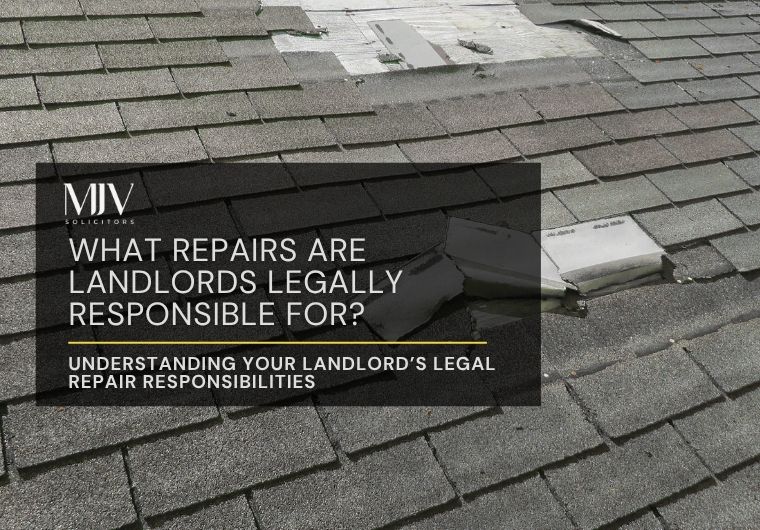
If a roof leak allows water into a property, a landlord will generally be responsible for repairing the roof because it forms part of the structure and exterior. Similarly, cracked external walls causing water penetration may fall within the landlord’s repairing obligations.
Water, Gas and Electrical Installations
Landlords must keep in repair installations supplying:
- Water.
- Gas.
- Electricity.
Examples include:
- Internal pipework.
- Electrical wiring.
- Consumer units.
- Water supply systems.
Sanitation
Landlords are generally responsible for installations relating to sanitation, including:
- Toilets.
- Baths.
- Sinks.
- Wash basins.
- Waste pipes.
- Drainage systems.
Heating and Hot Water
Section 11 also requires landlords to keep in repair and proper working order installations for:
- Space heating.
- Hot water.
This commonly includes:
- Boilers.
- Radiators.
- Heating controls.
- Water cylinders.
A complete heating failure during winter is one of the clearest examples of a repair issue that will often require urgent attention.
What Does “Keep in Repair” Actually Mean?
One of the most misunderstood areas of housing law is the meaning of the word “repair”.
Repair does not necessarily mean making something new. Nor does it necessarily require a landlord to upgrade an old feature to modern standards.
The courts have generally distinguished between:
- Repairing something that has deteriorated.
- Replacing something where replacement is necessary to effect a repair.
- Improving something beyond its original condition.
A landlord may be required to replace an old roof because replacement is the only practical method of repairing it. However, section 11 does not generally require a landlord to upgrade a perfectly functional roof simply because a newer design would be better.
What Is “Making Good”?
Many tenants assume that once repairs are completed, every visible consequence of the defect must also be remedied. This is not always correct. The concept of “making good” refers to works necessary to restore damage caused by the repair itself.
For example, if a landlord opens a wall to repair a leaking pipe, they would generally be expected to make good the wall afterwards. Similarly, if plaster has been removed to access defective wiring, reinstatement of the plaster may form part of the repair process.
However, making good does not necessarily mean completely redecorating a room. This distinction often becomes important in damp and mould cases.
Are Landlords Responsible for Redecoration?
This is one of the most common misconceptions in housing disrepair claims. Many tenants believe that because a wall has become stained by damp or mould, the landlord must automatically repaint the room. The legal position is more nuanced.
If decoration has been damaged by disrepair, the landlord may be required to make good damage caused by the defect or by the repair works. However, section 11 does not generally impose a free-standing obligation to redecorate a property simply because decoration has become old, worn or unattractive.
The precise position often depends on:
- The tenancy agreement.
- The nature of the defect.
- Whether redecoration is necessary to complete the repair.
Fitness for Human Habitation: Sections 9A and 10
The Homes (Fitness for Human Habitation) Act 2018 inserted sections 9A and 10 into the Landlord and Tenant Act 1985.
These provisions significantly expanded the protections available to tenants. Unlike section 11, which focuses on repair, sections 9A and 10 require that a property is fit for human habitation at the beginning of the tenancy and remains fit throughout the tenancy.
Section 10 identifies matters relevant to fitness, including:
- Repair.
- Stability.
- Freedom from damp.
- Internal arrangement.
- Natural lighting.
- Ventilation.
- Water supply.
- Drainage.
- Sanitary conveniences.
- Facilities for preparation and cooking of food.
- Disposal of waste water.
Our previous blog, What Makes a Property Unfit for Human Habitation?, provides further related information.
Why Fitness for Habitation Is Different from Repair
One of the most significant developments in housing law is that fitness for habitation can require works that go beyond repair. This is particularly important in damp and mould cases.
For example, a property may suffer from chronic condensation because it lacks adequate ventilation.
Nothing may be “broken” in the traditional sense. Nevertheless, if the property is unfit because of excessive moisture and inadequate ventilation, a landlord may need to carry out works that look more like improvements than repairs, such as installing extractor fans or improving ventilation systems. You can read further information in our guide: How Does Housing Disrepair Affect Your Health and What Can You Do?
This is one reason why damp and mould claims have become increasingly significant in recent years.
The Defective Premises Act 1972
Landlords may also owe duties under the Defective Premises Act 1972. The Act imposes duties where a landlord knows, or ought reasonably to know, about defects and has an obligation to repair or maintain the premises. It is primarily concerned with preventing personal injury and damage to property arising from defects.
The Act can be particularly important where defects cause:
- Personal injury.
- Accidents.
- Damage to possessions.
- Harm to visitors.
Like section 11 claims, knowledge of the defect is often a crucial issue.
What Repairs Are Landlords Usually Not Responsible For?
Understanding what landlords are not responsible for is just as important as understanding what they must repair.
Damage Caused by the Tenant
Landlords are generally not responsible for repairs made necessary by:
- Deliberate damage.
- Negligence.
- Misuse of the property.
For example, a door broken by a tenant may not fall within the landlord’s obligations.
Appliances
A common misconception is that section 11 requires landlords to repair all appliances within the property. This is not correct. Section 11 covers installations supplying gas, water and electricity, but does not generally require landlords to repair appliances such as:
- Washing machines.
- Tumble dryers.
- Dishwashers.
- Microwaves.
- Freestanding fridges.
However, a tenancy agreement may create additional contractual obligations.
Internal Decoration
As discussed above, landlords are not usually obliged to redecorate simply because decoration has become worn over time.
Improvements
Landlords are generally not required to improve a property merely because a newer system or better design exists. The law focuses on repair and habitability, not necessarily modernisation.
Tenant’s Own Possessions
Landlords are generally not responsible for maintaining or repairing:
- Tenant-owned furniture.
- Tenant-owned appliances.
- Tenant-installed fixtures.
Common Repairs Landlords Are Usually Responsible For
The following are examples of issues that frequently fall within landlord repairing obligations:
- Roof leaks.
- Defective guttering.
- Broken boilers.
- Heating failures.
- Faulty radiators.
- Defective windows.
- Water ingress.
- Plumbing leaks.
- Damaged drainage systems.
- Unsafe electrical installations.
- Structural cracks.
- Defective external doors.
- Damp caused by structural defects.
Whether liability arises will still depend on the individual facts of the case and, crucially, whether the landlord had notice of the issue.
Need Help with a Landlord Who Will Not Act?
Landlords in England and Wales have significant legal obligations under sections 9A to 11 of the Landlord and Tenant Act 1985 and the Defective Premises Act 1972. These obligations commonly cover the structure and exterior of a property, heating systems, plumbing, sanitation and electrical installations, as well as broader duties to ensure that homes remain fit for human habitation.
However, not every problem within a property is automatically the landlord’s responsibility. The law distinguishes between repairs, improvements, decoration and tenant-caused damage. Importantly, many repairing obligations only arise once the landlord has notice of the defect. For that reason, tenants should report issues promptly and keep clear records of when and how they were reported.
Understanding these distinctions can help both landlords and tenants better understand their respective rights and responsibilities and avoid many of the common misunderstandings that arise in housing disrepair disputes.
Housing Disrepair Solicitors
At MJV Solicitors, we help tenants take action when landlords fail to maintain safe and healthy properties. If you or a loved one’s health is being affected by disrepair, contact us today for specialist advice and support.
- Call us on 01253 858231
- Visit our website for more information about how to start your claim for Housing Disrepair
Read our previous blogs on the responsibilities of landlords and housing disrepair
- What Happens If My Landlord Won’t Do Repairs? Your Rights Explained
- What is Housing Disrepair? A Guide for Council and Housing Association Tenants
- Why Winter Makes Housing Disrepair Worse
- Can Leaseholders Claim Compensation for Disrepair?
- What Landlords Must Repair in Council or Social Housing
Frequently Asked Questions
Potentially. If damp and mould arise from defects, disrepair or conditions that render a property unfit for human habitation, the landlord may be responsible for remedying the underlying cause.
In most cases, yes. Landlords are generally not liable for failing to repair defects they were unaware of and could not reasonably have known about.
Not usually. Section 11 covers installations but does not generally require landlords to repair appliances unless the tenancy agreement provides otherwise.
Under fitness for habitation provisions, works may sometimes be required that go beyond traditional repair, particularly where a property is otherwise unfit for occupation.
Not usually as a separate obligation. However, redecoration or reinstatement may sometimes form part of making good damage caused by disrepair or repair works.
Tenants should keep copies of emails, letters, photographs, repair reference numbers and any other evidence showing when defects were reported and what response was received.