
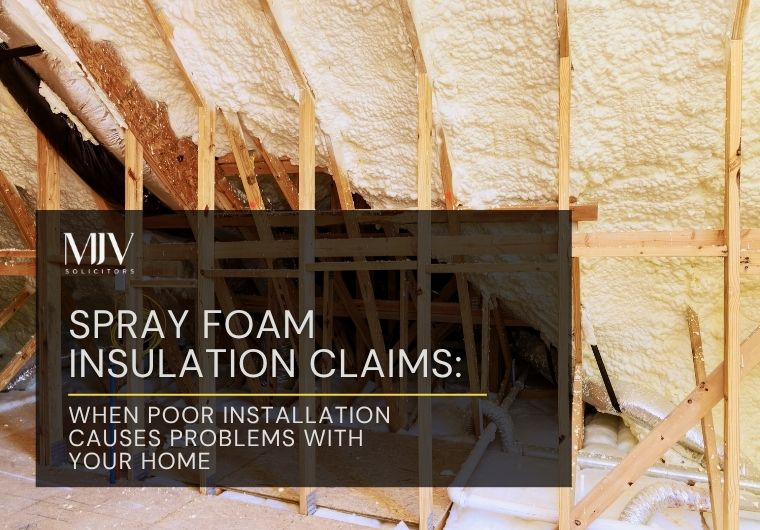
When Poor Installation Causes Problems with Your Home
Spray foam insulation claims have become increasingly common as more homeowners discover problems after having the product installed in their lofts, roof spaces, or other parts of their homes.
For some people, the issue is not simply regretting having spray foam installed. The real concern is that the insulation may have been installed poorly, may have caused or contributed to disrepair, or may have affected the value, saleability or mortgageability of the property.
At MJV Solicitors, we assist homeowners with spray foam insulation claims where there is evidence of a problem. This may include poor installation, damage to the property, moisture problems, condensation, timber issues, roof ventilation problems, or other defects linked to the installation.
We do not act for clients simply because they have changed their mind or wish they had not had spray foam insulation installed. A successful claim usually requires evidence of poor workmanship, breach of contract, negligence, misrepresentation, property damage, or another legally recognisable basis for recovery.
What Is Spray Foam Insulation?
Spray foam insulation is a type of insulation applied as a liquid foam, which then expands and hardens. It is commonly used in roof spaces, lofts and other areas of a property to improve thermal efficiency.
There are different types of spray foam insulation, including open-cell and closed-cell products. The suitability of spray foam depends on the property, the roof structure, the existing ventilation, the condition of the roof, the product used and the quality of the installation.
Spray foam insulation is not automatically defective. Some installations may have been carried out properly and may not cause issues. However, where spray foam has been installed without proper assessment, without adequate ventilation, over defective materials, or in a way that traps moisture or prevents inspection of the roof structure, serious problems can arise.
Why Are Spray Foam Insulation Claims Increasing?
The rise in these types of claims is driven by homeowners discovering problems with installation, mortgageability, or the roof structure, often only when they come to sell or remortgage.
In some cases, homeowners only become aware of an issue when they try to sell or remortgage their property. A buyer’s surveyor may raise concerns about the presence of spray foam insulation in the roof space. A mortgage lender may then refuse to lend, request further expert evidence, or require removal of the insulation before the transaction can proceed.
There is growing evidence that some mortgage lenders are cautious about lending on properties with spray foam insulation. This does not necessarily mean every property with spray foam insulation is un-mortgageable. However, the presence of spray foam can make the lending process more complicated, particularly when there is limited documentation, poor installation, inadequate ventilation, or no reliable evidence showing that the roof structure remains sound.
An inspection protocol has been developed to assist building professionals when assessing spray polyurethane foam applied to pitched domestic roofs. The purpose of that approach is to encourage assessment of the particular property and the particular installation, rather than treating every spray foam property in exactly the same way. In practice, however, homeowners may still face difficulties where lenders, valuers or surveyors are not satisfied with the installation or the available evidence.
Spray Foam Insulation and Mortgage Problems
One of the most common reasons homeowners seek advice is that spray foam insulation has affected a sale or remortgage.
Problems may arise where:
- a buyer’s lender refuses to lend;
- a surveyor cannot properly inspect the roof timbers;
- the spray foam has been applied directly to roof timbers or felt;
- ventilation appears inadequate;
- there is evidence of moisture, condensation or decay;
- there is no installation certificate, warranty or product documentation;
- the installer is no longer trading;
- the installer’s insurance is inadequate;
- the installation does not appear to meet the standard promised.
Mortgage concerns alone do not always mean there is a legal claim. A claim normally requires evidence that the installation was defective, that representations made at the time of sale were inaccurate, or that the homeowner has suffered loss because of breach of contract or negligence.
That distinction is important. We do not generally assist with claims based only on the fact that a homeowner now wishes they had chosen a different type of insulation. The focus is on legally recognisable claims where there is evidence of poor installation, property damage, financial loss or an actionable failure by the installer or another responsible party.
Poor Spray Foam Installation
A poor spray foam installation may give rise to a claim where the work was not carried out with reasonable care and skill, or where the result does not match what was agreed or represented to the homeowner.
Examples of potential poor installation issues may include:
- spray foam applied without proper assessment of the roof;
- inadequate ventilation after installation;
- foam applied to damp or defective roof timbers;
- foam applied in a way that prevents inspection of the roof structure;
- inappropriate product selection;
- failure to identify existing roof defects before installation;
- poor workmanship causing damage to the property;
- installation that contributes to condensation or trapped moisture;
- failure to provide promised documentation, guarantees or certification.
Not every concern will automatically amount to a claim. Evidence is important. This may include the contract, sales paperwork, photographs, expert reports, surveyor comments, mortgage correspondence, installation documents and any communications with the installer.
Spray Foam Insulation and Disrepair
Some spray foam insulation claims involve actual disrepair or damage to the property.
For example, a homeowner may discover that spray foam has contributed to condensation, damp, timber deterioration, or ventilation problems within the roof space. In other cases, spray foam may have been applied over existing defects, making the problem worse or more difficult to investigate.
Where spray foam insulation causes or contributes to disrepair, the claim may involve the cost of investigation, removal, remedial works, roof repairs, loss in property value, sale delays, or other financial losses.
These claims are fact-sensitive. A proper assessment will usually need to consider what condition the property was in before installation, what the installer promised, what work was carried out, what documentation was provided, and whether the installation caused or materially contributed to the problems later identified.
Breach of Contract Claims
Many spray foam insulation claims are brought as breach of contract claims.
A breach of contract claim may arise where the installer failed to carry out the works in accordance with the contract, failed to use reasonable care and skill, failed to provide what was promised, or supplied a product or service that did not meet the required standard.
The terms of the contract are important. These may be found in:
- the written quotation;
- the order form;
- the invoice;
- any guarantee or warranty;
- sales brochures;
- emails or letters;
- written representations made before installation.
In some cases, homeowners were told that spray foam insulation would improve the property, reduce bills, increase value, or not affect saleability or mortgageability. Whether those statements form part of a claim will depend on exactly what was said, whether it can be evidenced, and whether it was inaccurate or misleading.
Negligence Claims
A negligence claim may arise where the installer owed the homeowner a duty of care, breached that duty, and caused loss.
This may be relevant where the installer failed to assess the property properly, failed to identify obvious risks, installed the product in an unsuitable way, or caused damage to the property.
Negligence claims require evidence. It is not enough to show that spray foam insulation was installed and that the homeowner later experienced difficulties. There must usually be a link between what the installer did or failed to do and the loss suffered.
Expert evidence may be required, particularly where the claim concerns technical issues such as ventilation, timber decay, moisture, roof structure or the suitability of the product used.
Claims Against Installation Companies
In principle, a claim may be brought directly against the installation company. However, these claims can be difficult in practice.
One common problem is that the installer may no longer be trading. Another is that the installer may not have adequate insurance to meet a successful claim. Even where a homeowner has a strong claim on liability, recovery can be difficult if the defendant has no assets, no insurance, or has ceased trading.
For that reason, claims directly against installers often need to be considered carefully at the outset. Where a claim is brought only against the installer, we would usually act on a private paying basis rather than under a no win, no fee arrangement.
This is because the practical risk is not only whether the claim can be proved, but whether any damages can realistically be recovered if the claim succeeds.
Spray Foam Insulation Paid for on Credit: Claims Under the Consumer Credit Act
Some spray foam insulation claims may involve payments made by credit card, finance agreement or another regulated credit arrangement.
Where part of the cost was paid on credit, the Consumer Credit Act 1974 may be relevant. In some cases, this can allow a claim to be pursued against the credit provider rather than only against the installation company.
This can be particularly important where the installer has gone out of business, has no adequate insurance, or cannot meet a claim.
Whether the Consumer Credit Act applies will depend on the facts. Relevant issues may include:
- how payment was made;
- whether any part of the cost was paid by credit card;
- whether a finance agreement was used;
- the cash price of the works;
- the relationship between the homeowner, installer and credit provider;
- whether there was a breach of contract or misrepresentation.
Where the Consumer Credit Act is engaged, and there is evidence of defective installation, misrepresentation or another actionable issue, we may be able to consider acting under a conditional fee agreement or damages-based agreement.
No-Win, No-Fee: Conditional Fee Agreements and Damages Based Agreements
A conditional fee agreement is often referred to as a “no-win, no-fee” agreement. A damages based agreement is another form of funding arrangement where fees are linked to the damages recovered.
We may consider these funding options where the facts and evidence support a viable claim, and there is a realistic route to recovery. This is more likely where the Consumer Credit Act is engaged, because the credit provider may be legally responsible in circumstances where the installer is insolvent, uninsured or no longer trading.
We do not offer these funding arrangements for every spray foam insulation case. Each matter must be assessed individually, including prospects of success, evidence, likely value, recoverability and proportionality.
What Evidence Is Needed for a Spray Foam Insulation Claim?
Evidence is central to spray foam insulation claims.
Useful documents may include:
- the installation contract;
- quotation and invoice;
- finance agreement or credit card statement;
- sales literature;
- emails, letters or text messages from the installer;
- guarantee or warranty documents;
- product certificates;
- photographs before and after installation;
- surveyor reports;
- mortgage lender correspondence;
- estate agent correspondence;
- valuation evidence;
- expert reports about the roof or insulation;
- evidence of removal or remedial costs.
The stronger the evidence, the easier it is to assess whether there may be a claim and against whom the claim should be brought.
What Losses Can Be Claimed?
The losses recoverable in a spray foam insulation claim will depend on the facts.
Potential heads of loss may include:
- cost of removing defective spray foam insulation;
- cost of roof repairs;
- cost of remedial works;
- reduction in property value;
- wasted sale costs;
- surveyor or expert fees;
- additional mortgage or finance costs;
- consequential losses caused by the defective installation.
Not every loss will be recoverable in every case. The loss must usually be legally caused by the breach of contract, negligence, or misrepresentation relied upon. Evidence of the amount claimed will also be required.
Spray Foam Insulation Claims Are Not the Same as Buyer’s Remorse
It is important to be clear about what these claims are and what they are not.
A homeowner may be unhappy that they had spray foam insulation installed. They may now feel that the product has caused difficulties, or that they would not make the same decision again. That does not automatically create a legal claim.
A claim is more likely to require evidence that:
- the installation was defective;
- the installer failed to use reasonable care and skill;
- the homeowner was misled;
- the property suffered damage;
- the installation caused mortgage or sale problems;
- the installer failed to provide promised documentation;
- the Consumer Credit Act applies;
- financial loss has been suffered as a result.
This distinction helps ensure that claims are focused on cases where there is a proper legal basis for recovery.
Why Early Advice Matters
Spray foam insulation claims can become more difficult if evidence is lost or remedial work is carried out before the condition of the property has been properly documented.
Before removing spray foam, it may be important to obtain photographs, expert evidence and records showing the condition of the roof space. If the insulation is removed without evidence being preserved, it may become harder to prove what was wrong with the installation or what damage it caused.
Homeowners should also keep all paperwork relating to the original installation and any credit agreement used to pay for it.
Speak to MJV Solicitors About a Spray Foam Compensation Claim
Spray foam insulation claims are increasing because homeowners are encountering problems with poor installations, disrepair, mortgageability and saleability.
Not every spray foam installation will give rise to a claim. The key issue is whether there is evidence of defective work, misrepresentation, negligence, breach of contract, property damage or loss. Where the installer is no longer trading or does not have adequate insurance, claims may be difficult unless there is another route to recovery, such as a claim involving credit-funded works under the Consumer Credit Act.
At MJV Solicitors, we focus on claims where spray foam insulation has been installed to a poor standard, has caused or contributed to problems with the property, or where there is a realistic legal basis for recovery. We may consider claims against installers on a private paying basis, and we may consider alternative funding arrangements where credit was used, and the evidence supports a viable claim. If you think you may have a spray foam insulation compensation claim, get in touch, and our team will review your situation. Call us on 01253 858231 or make an online enquiry.
- Read our previous blog, “Spray Foam Insulation Scandal”
Frequently Asked Questions About Spray Foam Insulation Claims
Can I claim compensation for spray foam insulation?
You may be able to claim compensation if there is evidence that the spray foam insulation was installed poorly, caused damage, was mis-sold, or led to financial loss. Simply regretting the installation is unlikely to be enough.
Can spray foam insulation affect my mortgage?
Yes. Some mortgage lenders may be cautious about properties with spray foam insulation, particularly where the roof structure cannot be inspected properly or there is inadequate documentation. Each property and installation should be considered on its own facts.
What if the spray foam installer has gone out of business?
This can make a claim more difficult. If the installer is no longer trading or has no insurance, recovery may be problematic. However, if any part of the installation was paid for on credit, there may be another possible route under the Consumer Credit Act.
Can I bring a claim if I paid by credit card?
Possibly. If the Consumer Credit Act applies, a credit provider may be jointly responsible in some circumstances for breach of contract or misrepresentation. Whether this applies depends on the payment arrangements and the facts of the case.
Do you act in all spray foam insulation cases?
No. We focus on cases where there is evidence of poor installation, property damage, disrepair, misrepresentation or a viable legal claim. We do not generally act where the issue is only buyer’s remorse.
What evidence do I need for a spray foam insulation claim?
Useful evidence includes the contract, invoice, credit agreement, photographs, surveyor reports, mortgage lender correspondence, expert evidence, warranty documents and any communications with the installer.
Can I claim for the cost of removing spray foam insulation?
Potentially, if removal is necessary because of defective installation, damage, mortgageability issues linked to poor installation, or another legally actionable reason. The claim will depend on the evidence.
Can spray foam cause damp or roof problems?
Poorly installed spray foam may contribute to problems such as trapped moisture, inadequate ventilation or difficulty inspecting roof timbers. Whether it has caused damage in a particular case will usually require evidence.
Can I bring a no-win, no-fee spray foam claim?
We may consider a conditional fee agreement or damages based agreement where the evidence supports a viable claim, and there is a realistic route to recovery, particularly where part of the cost was paid on credit.
What should I do before removing spray foam insulation?
It is usually sensible to preserve evidence first. Photographs, expert inspection reports, surveyor comments and records of the condition of the roof space may be important if a claim is later pursued.
This article is for general information and does not constitute legal advice.