

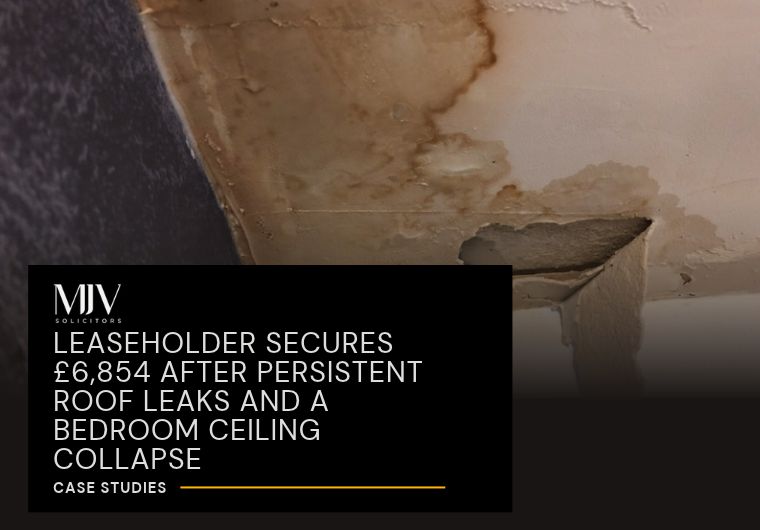
Case Study Overview: Roof Leaks the Landlord Failed to Resolve
MJV Solicitors acted for a leaseholder whose home had been repeatedly affected by water entering through the roof of her block. Despite numerous reports to her housing association over a prolonged period, the leaks continued, causing extensive water damage, damp, and mould in her bedrooms and living room.
The claim ultimately concluded with the housing association agreeing to pay £6,854 in compensation, complete the necessary remedial works and pay our client’s legal costs.
If you are a leaseholder dealing with roof leaks, damp, or water ingress, or your landlord is ignoring your concerns, find out more about how MJV Solicitors can help with leasehold disrepair claims.
For related information, please read Can a Leaseholder Claim Compensation for Disrepair?
Persistent Water Leaks Affecting the Home
Our client owned a second-floor leasehold flat and lived at the property herself. The problems concerned persistent water ingress affecting mainly her bedroom and living room.
The landlord’s own records demonstrated that the problems had been reported repeatedly. Records showed reports of rainwater entering the property from August 2022, followed by further reports in September and October 2022 and throughout 2023 and 2024. In June 2023, for example, the landlord recorded that our client had woken to find a puddle of water and was still experiencing water entering her home.
The consequences became particularly serious when, in April 2023, part of the bedroom ceiling collapsed while our client was in bed. Her correspondence showed that she had previously warned the landlord that she was concerned the ceiling might collapse. The problems nevertheless continued. By July 2024, our client was reporting that the water damage was “out of control” and that the condition of her home meant she was unable to have guests. In August 2024, she reported that she was living in fear of the bedroom ceiling falling again while she slept.
The Landlord’s Repairing Obligations
Although our client was a leaseholder rather than a tenant, this did not mean that she was responsible for repairing every part of the building.
The lease required the landlord, subject to its terms, to maintain and repair structural parts of the building, including the roof and external walls, together with relevant drainage and other communal infrastructure.
MJV Solicitors therefore pursued the claim as a breach of the repairing covenants contained within the lease. The Letter of Claim identified the bedroom and living-room leaks together with the resulting damp, mould and water damage and sought both compensation and performance of the landlord’s repairing obligations.
For related information, please read: Can a Leaseholder Claim Compensation for Disrepair?
Independent Surveyor Identifies Problems with the Roof
We instructed an independent Chartered Surveyor to investigate the cause and extent of the disrepair.
The surveyor was able to inspect the roof because scaffolding was present. He found a significant amount of water pooling on the flat roof and observed that hoppers were blocked with debris. His opinion was that the lack of maintenance, together with poor installation, had caused water to pool and subsequently leak into the property.
He concluded that the blocked hoppers and poor roof installation had caused, and continued to cause, the water pooling, and that the leaks could continue unless the underlying problem was properly resolved.
Inside the living room, the surveyor found bubbling paint, water damage to the ceiling and around the patio doors, flaking paintwork and returning mould.
He recommended works to address the roof and drainage problems together with making good the damaged internal areas. The total value of the works he identified was £2,450 plus VAT, with an estimated completion period of one month.
Landlord’s Own Survey Reveals Saturation Levels Above 70%
The evidence became even stronger when the landlord arranged a further inspection in February 2025. Its surveyor confirmed that roof replacement works were already underway to address the primary cause of water ingress into flats in the block.
In the main bedroom, the landlord’s surveyor found damaged plasterboard, damp and mould to the ceiling and external wall, damaged decorative finishes and a temporary plastic screen which had been installed to contain water entering from above. Damp-meter readings exceeded 70% saturation. The living room was similarly affected. Its plasterboard ceiling was described as severely damaged, with visible damp and mould, water damage around the patio doors and moisture readings again exceeding 70% saturation.
The inspection also identified a more recent leak affecting the second bedroom. The landlord’s surveyor concluded that the outstanding internal repairs would need to be undertaken once the roof repairs had been completed and the building made watertight.
The Outcome for Our Client: £6,854 Compensation Plus Repairs
Following negotiations, the housing association made a Part 36 offer to settle the claim.
The landlord agreed to pay our client £6,854 in compensation. Importantly, the settlement was not restricted to money: the housing association also agreed to undertake the remedial works identified by its surveyor within 90 working days, subject to access, completion of the external works and the necessary internal drying period.
MJV Solicitors accepted the offer on our client’s behalf on the basis that the housing association would also pay her legal costs on the standard basis. The result therefore secured three important outcomes for our client:
- £6,854 compensation
- An agreement for the outstanding repairs to be completed
- Payment of her legal costs.
Why This Case Matters for Leaseholders
Housing disrepair claims are not restricted to council or housing-association tenants.
A leaseholder may have a claim where the source of a problem falls within parts of the building which the freeholder or landlord has agreed to maintain under the lease. Roofs, structural walls, communal drainage and other common parts are frequently matters for which the landlord retains responsibility, although the wording of the individual lease must always be considered.
This case also demonstrates the importance of looking beyond temporary internal repairs. Repainting a water-damaged ceiling will not resolve a defect if water continues to enter through the roof. Here, the independent expert identified water pooling on the flat roof and blocked drainage as part of the underlying problem. The landlord’s subsequent survey confirmed serious continuing moisture within the property, and that roof replacement works were required to address the primary source of the water ingress.
Need Help with a Leaseholder Roof Leak or Damp Claim?
This case involved persistent roof leaks, extensive water damage, damp and mould and even a partial ceiling collapse. Despite repeated reports, the underlying problem remained unresolved for a substantial period.
Through the claim, MJV Solicitors obtained independent expert evidence identifying the underlying defects and ultimately secured £6,854 in compensation, along with an agreement requiring the housing association to complete the outstanding remedial works and pay our client’s legal costs.
For leaseholders experiencing water ingress, roof leaks, damp, mould or defects arising from the structure or common parts of their building, the terms of the lease should be considered carefully to establish whether responsibility rests with the landlord or freeholder.
Contact us today on 01253 858231 or email claims@mjvlaw.co.uk for straightforward, effective legal support.
Related Leasehold and Housing Disrepair Guides
You may also find these guides helpful:
- Can My Landlord Blame Condensation for Damp and Mould? A Complete Guide for Tenants
- Can a Leaseholder Claim Compensation for Disrepair?
- What Repairs Are Landlords Legally Responsible For?
- What Happens If My Landlord Won’t Do Repairs? Your Rights Explained
- What Makes a Property Unfit for Human Habitation?
- What Is Housing Disrepair? A Guide for Council and Housing Association Tenants
- How to Gather Evidence for a Housing Disrepair Claim
- How Does Housing Disrepair Affect Your Health and What Can You Do?
Read More of Our Successful Leasehold Disrepair Claims
- Long Leaseholder and Family Return Home After £8,000 Disrepair Claim, Long-Term Decant and Breach Action
- Leaseholders Secure £9,250 Compensation After Years of Damp and Roof Leaks
- Leaseholder Secures £6,650 Compensation and Repairs After Years of Roof Leaks
- Leaseholders Secure Compensation After Years of Heating Failures and Roof Leaks
- Leaseholder Wins £11,150 Compensation After Decade of Roof Leaks and Freeholder Inaction
- Leaseholder Secures Compensation for Defective Front Door and Windows
- Long Leaseholder Secures £5000 After Repeated Disrepair Issues
Frequently Asked Questions
Potentially, yes. The starting point is the lease. Where the landlord or freeholder has accepted responsibility for maintaining the part of the building causing the problem, a leaseholder may be able to pursue a claim if those obligations have been breached.
This depends upon the lease, but responsibility for the structure, roof and common parts of a block will often remain with the freeholder or landlord. In this case, the landlord’s repairing covenant extended to structural parts of the building, including the roof.
Previous attempts at repair do not necessarily resolve the landlord’s obligations if the underlying defect remains. Evidence of repeated reports, repair records, photographs and expert evidence can be important in establishing the history of the problem.
The completion of repairs does not necessarily extinguish a claim for the period during which the property was affected. Whether compensation is recoverable and its amount will depend upon the particular facts and evidence.
Yes. In this case, the settlement provided for both £6,854 compensation and completion of specified remedial works.